Abstract
Robots are improving their autonomy with minimal human supervision. However, auditable actions, transparent decision processes, and new human-robot interaction models are still missing requirements to achieve extended robot autonomy. To tackle these challenges, we propose RODEO (RObotic DEcentralized Organization), a blockchain-based framework that integrates trust and accountability mechanisms for robots. This paper formalizes Decentralized Autonomous Organizations (DAOs) for service robots. First, it provides a ROS-ETH bridge between the DAO and the robots. Second, it offers templates that enable organizations (e.g., companies, universities) to integrate service robots into their operations. Third, it provides proof-verification mechanisms that allow robot actions to be auditable. In our experimental setup, a mobile robot was deployed as a trash collector in a lab scenario. The robot collects trash and uses a smart bin to sort and dispose of it correctly. Then, the robot submits a proof of the successful operation and is compensated in DAO tokens. Finally, the robot re-invests the acquired funds to purchase battery charging services. Data collected in a three day experiment show that the robot doubled its income and reinvested funds to extend its operating time. The proof validation times of approximately one minute ensured verifiable task execution, while the accumulated robot income successfully funded up to 88 hours of future autonomous operation. The results of this research give insights about how robots and organizations can coordinate tasks and payments with auditable execution proofs and on-chain settlement.
RODEO architecure
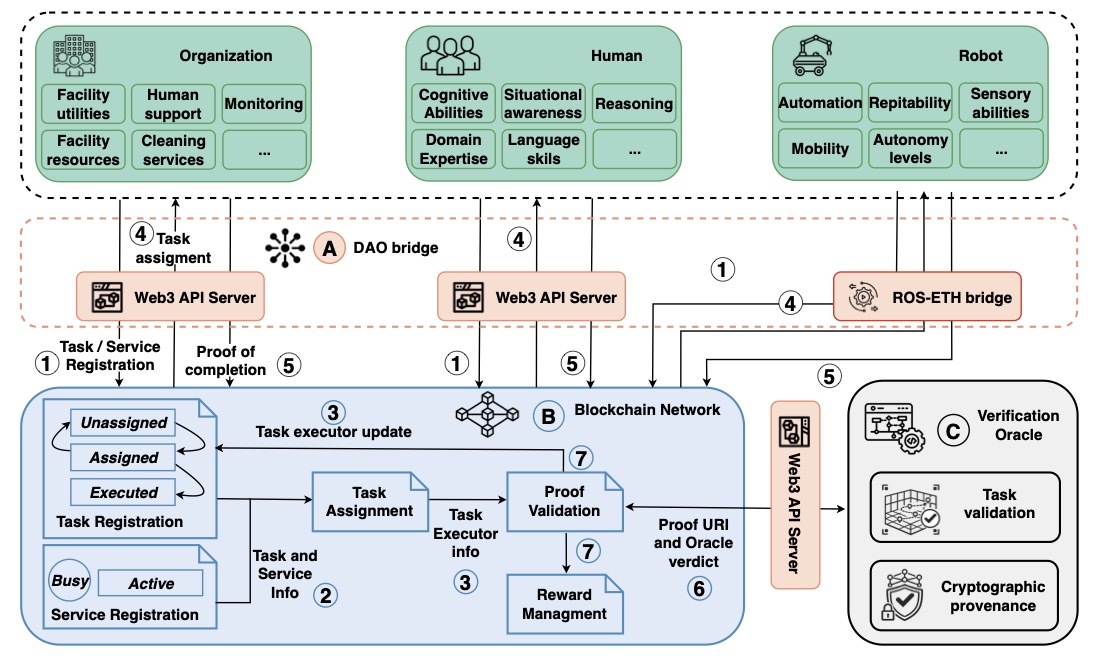
RODEO is organized into three primary architectural building blocks that work together to enable autonomous, accountable robot operations within decentralized organizations:
- DAO bridge - The DAO bridge serves as the interface layer between all participants in the blockchain network. It provides organizations, humans, and robots with a common programmable API to publish tasks and services, receive assignments, manage rewards, and observe state updates.
- Blockchain network - The blockchain network addresses the critical issues of trust and liability. It functions as a transparent, tamper-proof ledger that records participant interactions, task completion proofs, and robot data in a way that cannot be altered. Smart contracts define organizational rules.
- Verification oracle - The verification oracle provides an auditable source of truth by ensuring reward settlement is based on verified physical performance. It validates that task execution proofs are legitimate and unmanipulated and performs emulation-based verification.
Use Case: Cleaning and charging in a university lab The waste disposal workflow
- Organization creates task - When trash is found in the lab, the organization creates a waste disposal task using a web interface. The system assigns it to an available robot.
- Robot picks trash -The robot navigates to the tagged waste item, uses its manipulator to grasp the object, then drives to the iTrash smart bin.
- Disposes correctly - The robot presents the grasped item to the iTrash camera, queries the classification service, and receives a completion flag after dropping the item in the correct bin.
- Submits proof - After task completion, the robot uploads a rosbag file containing its base trajectory, manipulator poses, gripper release confirmation, and the iTrash success message as verifiable proof.
- Oracle validates - The verification oracle downloads the rosbag, replays it in Gazebo at 3× speed, and verifies execution checkpoints: pick-and-place stops, manipulator poses, gripper release, and iTrash message.
- - Robot receives 100 IEC Upon successful validation, the smart contract releases the escrowed 100 IEC tokens to the robot’s wallet, compensating it for the completed service.
- - Battery low, robot creates charging task - When the robot’s battery reaches 50%, it autonomously creates a charging task and navigates to the charging area.
- Charging costs 200 IEC - The robot completes a battery charging session at a fixed electricity tariff of 200 IEC paid to the organization.
- Organization submits charging proof - After the charging session completes, the organization submits energy consumption logs as proof of service delivery.
- Robot reinvests earned funds to extend autonomy -The oracle validates the charging proof, the smart contract deducts 200 IEC from the robot’s wallet, and the robot is ready to continue autonomous operation—effectively reinvesting its task earnings to extend its operational lifetime.
Publications
Team Members
Eduardo Castelló Ferrer
Assistant Professor - School of Science & Technology
Milan Groshev
Postdoctoral Research Associate